
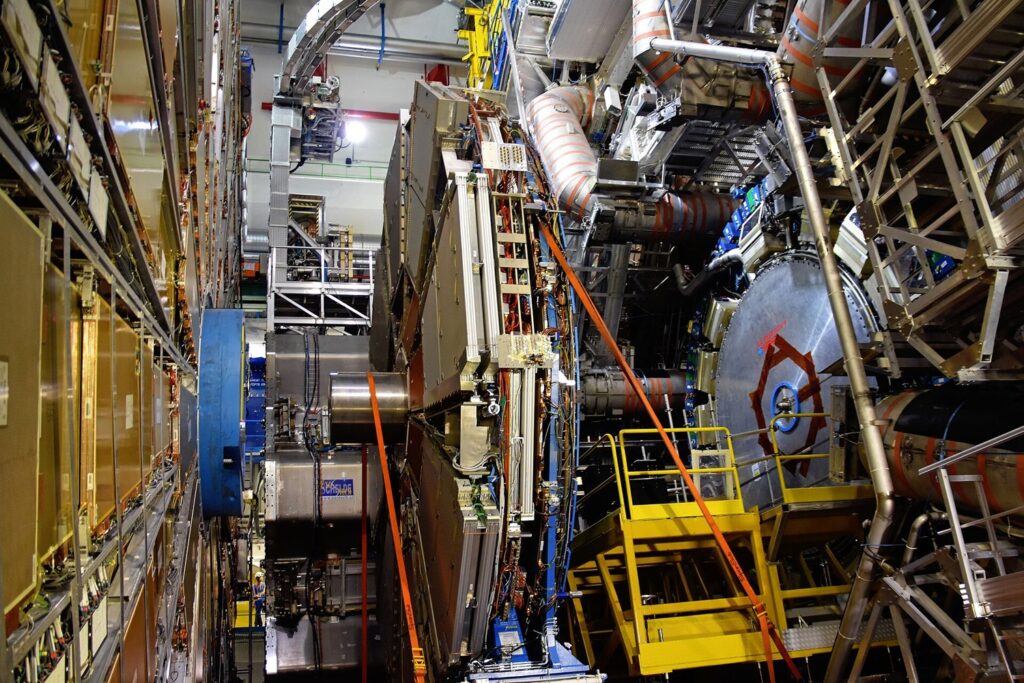
Vacuum tunnelling: CERN’s ATLAS sees first hint of QCD instantons
Physicists at CERN may have caught the first glimpse of vacuum tunnelling, a strange quantum effect predicted about 50 years ago. The ATLAS Collaboration at the Large Hadron Collider (LHC) reported on 27 November 2026 an unexpected excess of collisions that look like so-called QCD instanton events. However, the team stresses that the signal is a hint, not a discovery.
What ATLAS saw in its vacuum tunnelling search
The result comes from the first dedicated search for QCD instantons at the LHC. In theory, these processes happen when the field of the strong force “tunnels” from one configuration of empty space to another. The idea goes back to work by Nobel laureate Gerard ‘t Hooft in 1976.
Instanton events are hard to spot. They are expected to spray many low-energy particles in all directions, like a spherical firework. Ordinary proton collisions can produce a very similar pattern.
To get a clearer view, the researchers used a special dataset recorded in 2015. At that time, the LHC ran with very few overlapping collisions. The team then trained neural networks to recognise the round shape of instanton-like events. They also estimated the background directly from the data.
The analysis found more of these spherical, particle-rich events than the best models of ordinary collisions predict. In the most sensitive region, ATLAS counted 32,789 events. About 28,800 are attributed to ordinary collisions and about 3,900 to a possible instanton signal.
A 3.5-sigma hint, not yet a discovery
The excess has an observed significance of 3.5 standard deviations. By comparison, particle physicists normally require five standard deviations before claiming a discovery. According to the preprint, the expected significance was only 1.5 standard deviations.
The fitted signal rate is 2.3 times the benchmark prediction, with an experimental uncertainty of 0.6. Yet the theoretical prediction itself is uncertain by orders of magnitude. As a result, more precise calculations are needed to interpret the comparison.
The paper also notes that no background-only model fully describes the data. In addition, the authors say the interpretation is limited by how well low-energy collisions are modelled. Further checks of the signal’s properties are required to verify the instanton hypothesis.
“The challenge now is to find out whether the same explanation holds for other types of collisions and with different analysis methods,” said Ynyr Harris, a Humboldt Research Fellow at the University of Bonn, which played a leading role in the analysis with colleagues from Oxford and Prague.
Why the result matters for physics
Instantons do not create matter. Instead, they can flip the “handedness” of quarks. Still, they belong to the same family of topological processes as electroweak sphalerons. Those related transitions could, in theory, change the total amount of matter in the universe.
That link matters because the Big Bang is thought to have produced equal amounts of matter and antimatter. Something must have tipped the balance. A confirmed instanton signal would therefore let scientists study this kind of field topology in the laboratory.
“If we could detect a QCD instanton process … we could begin to measure the topological structure of empty space,” said Matthias Schott, professor of experimental particle physics at the University of Bonn.
Next, the researchers plan to extend the search to other collision types, such as those in which one or both protons emerge intact. More data and better models should show whether the excess holds up.